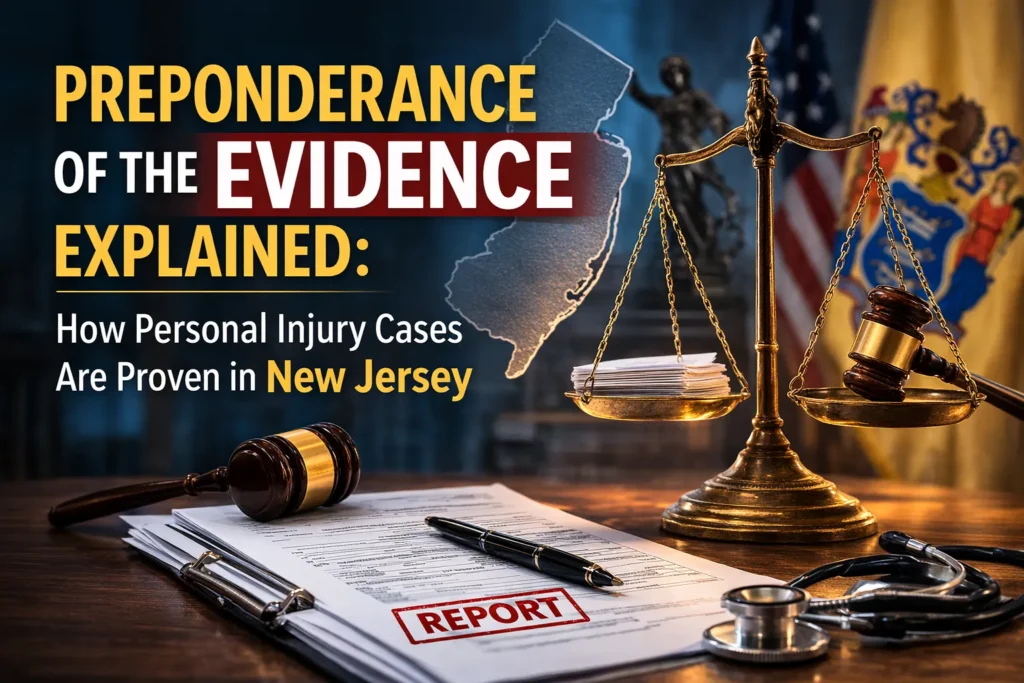
Preponderance of the evidence decides most personal injury cases in New Jersey. Courts skip absolute proof after an accident lawsuit. They just check if evidence makes one story more likely true than the other.
That’s how the personal injury legal process rolls in civil courts. Lawyers pull together records, statements, reports, and expert views. All that personal injury claim evidence paints the real picture of what went down. When facts tip slightly one way, the job’s done.
Grasp this, and you see how victims nail negligence plus how courts handle the civil lawsuit burden of proof. It spotlights why evidence rules civil suits.
What Is Preponderance of the Evidence
In civil law, Preponderance of the evidence means that the evidence shows something is more likely true than not. The court compares both sides and decides which explanation carries more weight.
This is known as the preponderance of the evidence standard, which is the main Civil litigation evidence standard used in personal injury cases.
Think of it in simple terms. If the evidence suggests there is a 51 percent chance one side is correct and a 49 percent chance the other side is correct, the case is decided in favor of the stronger evidence.
Key points to understand
- The evidence must slightly favor one side
- Absolute proof is not required
- The court compares both arguments carefully
- The side with stronger evidence meets the burden of proof civil case
This is why building a strong evidence record is critical in injury lawsuits.
Why Civil Cases Use This Standard
Civil courts focus on responsibility and compensation rather than punishment. Because of this, the law uses a lower evidence requirement than criminal cases.
The civil lawsuit burden of proof simply asks whether the evidence makes one explanation more believable than the other. Once the evidence crosses that threshold, Preponderance of the evidence has been satisfied.
This approach allows injured individuals to seek compensation without needing the extremely high level of proof required in criminal court.
Simple Example of How Evidence Is Measured
Courts often explain the rule using a balance scale.
| Evidence Comparison | Result |
| Both sides equal | No decision |
| One side slightly stronger | Meets Preponderance of the evidence |
| One side overwhelmingly stronger | Strong civil claim |
Even a small advantage in the evidence can decide the case.
Proving Negligence in New Jersey
Winning a personal injury case means successfully Proving Negligence in New Jersey. Negligence happens when someone fails to act with reasonable care and causes harm to another person. Courts rely on Preponderance of the evidence to decide whether negligence occurred.
Elements required for proving negligence
- Duty of care
- The responsible party had a legal obligation to act safely
- Breach of duty
- That obligation was not followed
- Causation
- The breach directly caused the injury
- Damages
- The victim experienced measurable harm such as medical expenses or lost income
Each of these elements must be supported by reliable Personal injury claim evidence.
Types of Personal Injury Claim Evidence
Strong evidence forms the backbone of every injury lawsuit. Courts examine multiple types of documentation to understand what happened.
Common forms of Personal injury claim evidence
- Medical records
- Show the injury, treatment history, and long term impact
- Police or accident reports
- Provide official documentation of the incident
- Photos or videos
- Capture the accident scene, property damage, or hazardous conditions
- Witness testimony
- Offers independent observations of the event
- Expert opinions
- Professionals explain complex topics such as medical complications or accident reconstruction
When these forms of evidence collectively support one version of events, they help satisfy the preponderance of the evidence.
Civil vs Criminal Evidence Standards
Civil and criminal courts use different evidence requirements.
| Case Type | Evidence Requirement |
| Criminal trial | Beyond reasonable doubt |
| Civil lawsuit | Preponderance of the evidence |
Criminal cases require extremely strong proof because the consequences include imprisonment. Civil lawsuits focus on compensation, so the Civil litigation evidence standard is lower.
This difference explains why some incidents may not lead to criminal convictions but can still result in successful civil claims.
Steps in the Personal Injury Legal Process
The Personal injury legal process involves several stages where lawyers gather and present evidence.
Investigation stage
- Lawyers examine the accident details
- Evidence collection begins
- Witnesses may be interviewed
Filing the claim
- A formal complaint is submitted in court
- The defendant responds to the allegations
Discovery phase
- Both sides exchange documents and information
- Depositions and expert analysis may occur
Negotiation
- Attorneys discuss settlement options
- Evidence strength often determines settlement value
Trial
- If no settlement occurs, the case goes to court
- The judge or jury applies Preponderance of the evidence
How Lawyers Build Strong Evidence
Lawyers carefully organize information to make the case clear and convincing.
Common legal strategies
- Creating a detailed timeline of events
- Connecting medical records directly to the accident
- Presenting expert testimony to explain technical details
- Using consistent witness accounts to strengthen credibility
These steps help show that the claim meets the preponderance of the evidence and fulfills the burden of proof civil case requirement.
Visual Example of Evidence Strength
A simple way to picture this rule is through probability.
| Side | Evidence Strength |
| Defendant explanation | 45 percent |
| Plaintiff explanation | 55 percent |
Because the injured person’s evidence is stronger, the court determines that Preponderance of the evidence has been satisfied.
Mistakes That Can Weaken Personal Injury Claims
Some cases fail not because the accident did not happen, but because the evidence is weak or incomplete.
Common problems seen in civil lawsuits
- Delaying medical treatment
- Creates doubt about whether the injury was serious
- Missing documentation
- Weakens proof of damages
- Inconsistent statements
- Raises questions about credibility
- Lack of expert testimony
- Complex injuries often require professional explanation
These issues can prevent a case from reaching the Preponderance of the evidence threshold.
Why Evidence Preparation Matters
Civil courts depend entirely on documented facts. Judges and juries cannot rely on assumptions or speculation.
The stronger the evidence, the easier it becomes to meet the civil lawsuit burden of proof. When records, testimony, and expert analysis consistently support the claim, Preponderance of the evidence becomes easier to establish.
This is why attorneys focus heavily on evidence collection from the beginning of a case.
Conclusion:
Understanding the preponderance of the evidence helps explain how personal injury cases are decided in New Jersey. Civil courts focus on probability rather than absolute certainty. When the available facts show that negligence is more likely than not, the legal standard has been met.
Frequently Asked Questions
What Does Preponderance of the Evidence Mean?
It means the court sees one side’s story as more likely true—like tipping scales just over 50%. Proof slightly favoring your accident explanation meets the civil lawsuit bar.
Why Use It in Injury Cases?
Courts pick it for money claims, not jail time. Focus stays on likely fault with everyday evidence, not total proof.
Key Evidence for Claims?
Medical records, photos, reports, witnesses, experts, footage. They align to prove negligence best.
Who Bears Proof Burden?
The injured party must show the defendant more likely caused it.
No Witnesses Needed?
Yes—docs, reports, photos, experts can suffice.
Why Medical Records Matter?
They link accidents to injury, treatment, and costs.
Equal Evidence Outcome?
Claim fails; scales don’t tip.
Cases Go to Trial?
Most settle early, but proof gets judged the same way.
Evidence Collection Time?
Weeks to months, based on case size.
Why Lawyers Stress Evidence?
It’s the case base—strong stuff wins under the standard.