
When airbags failed to deploy in accident situations, it is natural to wonder whether something went wrong. If the front of the car was damaged, you should assume that the airbags would’ve inflated in the event of a serious collision.
Airbags don’t come with a magic formula that will always protect drivers and passengers. The deployment will depend on the direction and magnitude of impact, sensor readings, vehicle design, and the expectation that deployment will benefit the occupants.
Why Didn’t My Airbags Deploy?
The first thing to know if you are asking, why didn’t my airbags deploy? It is that damage to the vehicle does not automatically mean that the airbags should have deployed. Exterior damages may be serious, but are not considered airbag deployment conditions.
Frontal airbags are typically intended for moderate to severe frontal or near frontal crashes. Acceleration and impact patterns may not result from some collisions that could trigger them.
Airbags Didn’t Deploy in Front End Collision: Why?
People are often surprised when airbags didn’t deploy in front end collision cases. But, where and how it hits do matter. Damage to the front of a vehicle may occur that does not register as the appropriate sensor readings for deployment.
NHTSA says the activation of airbags is a complex process based on the nature of the crash, such as speed, impact direction, other cars involved, airbag system design, and airbag sensor placement.
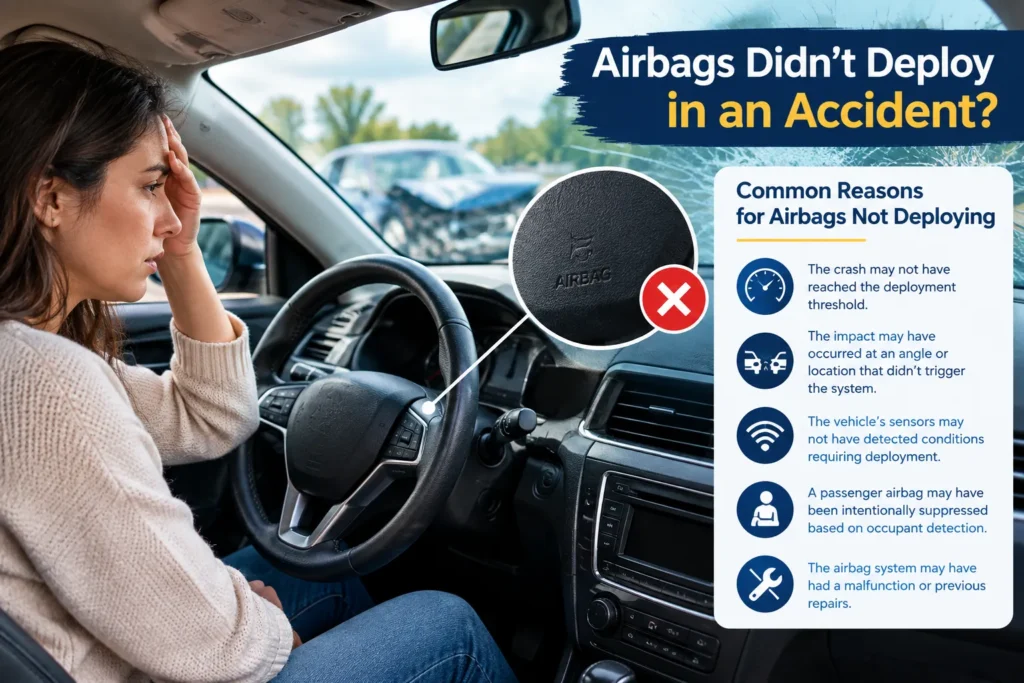
Common Reasons for Airbags Not Deploying
There are several possible explanations for airbags failed to deploy in accident situations:
- The crash may not have reached the deployment threshold.
- The impact may have occurred at an angle or location that did not trigger the system.
- The vehicle’s sensors may not have detected conditions requiring deployment.
- A passenger airbag may have been intentionally suppressed based on occupant detection.
- The vehicle may have had a previous crash and improperly replaced or unreplaced airbag components.
- A component of the airbag system may have malfunctioned.
A few systems are also able to disable the passenger airbags if other occupants are in the car or for specific seating positions.
What Is Airbag Deployment Failure?
Airbag deployment failure is not the same as when the airbags properly failed to deploy when the crash failed to meet the deployment criteria of the airbags.
If you think the airbags should have inflated, take the vehicle to a technician who is trained to deal with airbags. The inspection can help identify whether the system is operating correctly, if there were any previous repairs and if there was a relevant recall or defective component on the vehicle.
In an injury-producing collision, NHTSA recommends that any airbag that does not deploy be reported in order to investigate possible airbag safety defects.
What Should You Do After the Accident?
If airbags didn’t deploy in an accident, keep as much information regarding the accident as possible. An automobile accident attorney can help you understand what evidence may be important if the crash resulted in injuries. Do not dispose of any pictures of the car, car damage, the roadway, other cars, or any airbag or dashboard warning.
Avoid allowing repairs or changes in the safety systems, before the cause of the non-deployment is properly considered, particularly if there is a legal claim. Maintain repair records, medical records, police report, insurance information, and vehicle history, if available.
Can You Sue if Your Airbags Don’t Deploy?
So, can you sue if your airbags don’t deploy? Maybe, but it depends on both why the airbags did not deploy and whether or not that was the fault for your injuries.
If a vehicle’s airbag system failed to function properly due to a faulty product or bad repair, a product liability lawyer can help determine whether the vehicle manufacturer, parts manufacturer, repair shop, or another party could be held accountable. But if an airbag is not deployed, that is not sufficient to conclude that there is a defect in the airbag.
Conclusion:
If your airbags failed to deploy in accident circumstances, do not immediately assume that the system was defective. Airbags are designed to deploy under particular crash conditions, and they are not intended to inflate in every collision.
However, if the crash caused significant injuries and you believe the airbag system should have protected you, it is worth having the vehicle properly inspected
Frequently Asked Questions
Why didn’t my airbags failed to deploy in accident when I hit a car?
Airbags may not deploy because of the crash direction, severity, sensor readings, vehicle design, or other conditions. They are not designed to deploy in every collision.
Why didn’t my airbags deploy in a front-end collision?
A front-end collision does not automatically trigger airbags. The impact must meet the vehicle’s deployment conditions based on factors such as direction, severity, and sensor readings.
Is it normal for airbags not to deploy?
Yes, in some crashes. Airbags are supplemental restraints designed to deploy in particular moderate-to-severe crash conditions rather than every accident.
What is airbag deployment failure?
It refers to a situation where an airbag does not deploy when the system should have activated. A professional inspection is usually needed to determine whether an actual malfunction occurred.
Can airbags fail because of a previous accident?
They can be affected if the vehicle was previously crashed and airbags or related components were not properly replaced. NHTSA recommends replacing deployed airbags after a crash.
Should I drive my car if the airbags did not deploy?
If you have concerns about the airbag system or another safety component, have the vehicle inspected before continuing to drive it. A qualified technician can check the restraint system.
Can a vehicle have major damage without deploying airbags?
Yes. The amount of visible damage does not by itself determine whether airbags should have deployed. Crash direction, sensor data, and the type of impact also matter.
Can you sue if your airbags don’t deploy?
Possibly. A claim may exist if evidence shows that a defective airbag system or another party’s negligence caused or worsened injuries. The specific facts and applicable state law matter.
What should I do if my airbag did not deploy and I was injured?
Seek appropriate medical care, preserve evidence, document the vehicle and crash, and consider having the airbag system professionally inspected before repairs are completed.
Who may be responsible for an airbag failure?
Depending on the circumstances, responsibility could potentially involve a vehicle manufacturer, parts manufacturer, repair facility, or another party. An investigation is needed to determine what happened.