Assumption of risk shows up right when people think their case is strong. Someone gets injured, everything looks clear, and then this one concept starts pulling the case in a different direction.
Here is how it usually plays out. The situation already has some danger. That danger is visible. It is not hidden. The person steps into it anyway. Later, when the injury happens, the law looks back and asks a simple question: was that risk already understood and accepted?
That is where assumption of risk in personal injury starts to matter. It is not only about who caused the injury. It is also about whether the injured person chose to take that risk in the first place.
What is the Assumption of Risk?
assumption of risk is about accepting danger before anything goes wrong. In assumption of risk law, this becomes a way to decide who should be responsible after an injury.
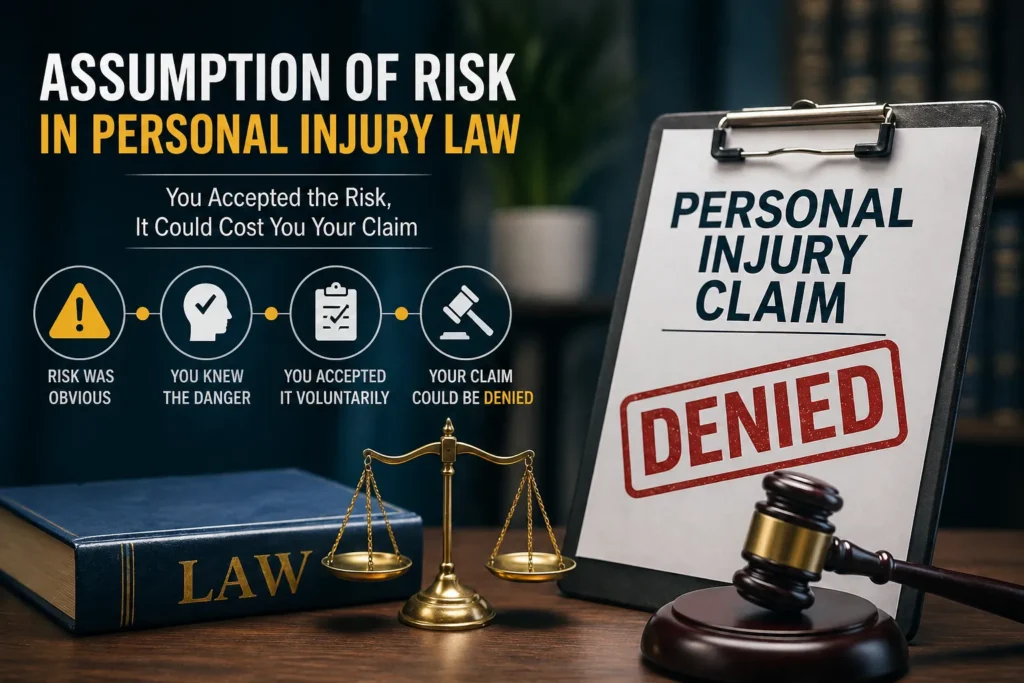
Picture a situation where the risk is obvious. The person sees it. Understand it. Still moving forward. That decision becomes important later.
What courts usually check:
- Was the danger clear and visible
- Did the person understand what could happen
- Was the choice made freely
When these points are clear, the assumption of risk defense becomes stronger.
Understanding express vs implied assumption of risk
The difference between express vs implied assumption of risk comes down to how the risk is accepted.
Express Assumption of Risk
This one is clear and direct.
- A waiver gets signed
- Rules are accepted before starting
- Risks are explained in writing or clearly stated
There is proof here, so it becomes easier to show.
Implied Assumption of Risk
This one comes from actions.
- A person joins something risky without hesitation
- Warning signs are visible but ignored
- The situation itself makes the danger obvious
No written agreement is needed here. Behavior tells the story. This is why it often shows up in legal defenses in personal injury cases.
Clear assumption of risk examples
Looking at simple assumption of risk examples makes everything easier to understand.
Everyday situations:
- Sitting close to the field during a sports match
- Riding fast on a rough road without safety gear
- Joining a contact sport where injuries are common
- Walking into an area marked as dangerous
In all these situations, the risk is right there. Nothing is hidden. That is why what is assumption of risk becomes clear through real-life actions.
How the Assumption of Risk Defense Works
The assumption of risk defense changes the focus of a case. It stops being only about what went wrong. It becomes about what was already known.
What usually happens:
- The defense points out the obvious risk
- Evidence is used to show awareness
- The injured person’s decisions are examined
If everything lines up, compensation can drop or disappear. That is why this is one of the most common personal injury claim denied reasons.
Is assumption of risk a complete defense?
A lot of people ask: is assumption of risk a complete defense?
The answer depends on the details.
Possible results:
- The claim is completely denied
- Compensation is reduced
- Responsibility is shared between both sides
Courts often compare negligence vs assumption of risk before making that call.
Looking at negligence vs assumption of risk
These two ideas are connected but different.
| Point | Negligence | Assumption of Risk |
| Focus | Someone failed to act carefully | Someone accepted the danger |
| Responsibility | On the defendant | Shared or shifted |
| Outcome | Higher chance of compensation | Lower or no compensation |
Even when negligence plays a role in the situation, assumption of risk can still reduce the final outcome.
When assumption of risk can deny a claim
This is where many people get caught off guard. A claim looks strong, but then it gets denied.
Common situations:
- Warning signs are ignored
- Risky activities are chosen willingly
- Waivers are signed without attention
- The danger is obvious, but still ignored
These are some of the most frequent personal injury claim denied reasons, and they often connect back to one thing: the risk was already accepted.
What courts actually pay attention to
Courts take a closer look before applying assumption of risk law.
Key things they consider:
- Was the risk obvious or hidden
- Were proper warnings given
- Did the person truly understand the risk
- Did the other party act recklessly
If the risk was not clear or the situation was forced, the defense may not hold the same weight.
How to avoid losing a claim
Avoiding problems with assumption of risk in personal injury comes down to awareness.
Simple actions that help:
- Read every document before signing
- Take warnings seriously
- Avoid situations where risk is clear
- Keep proof if something feels unsafe
These small decisions can shape what happens later.
Conclusion:
This concept changes how responsibility is seen. It is not just about what happened. It is about what was already accepted before it happened.
That is why assumption of risk plays such a strong role in legal defenses in personal injury cases. It can protect one side and weaken the other at the same time.
Understanding it makes the difference between moving forward with a claim and watching it fall apart.
Frequently Asked Questions
What is the assumption of risk in simple words?
It means a person sees a risk, understands it, and still decides to move forward, which can reduce or completely remove their chance of getting compensation later.
How does assumption of risk law affect a claim?
It allows courts to look at whether the injured person accepted the danger before the injury, which can lower or deny compensation depending on the situation.
What are common assumptions of risk examples?
Examples include playing contact sports, ignoring warning signs, or joining risky activities where the danger is already clear and understood.
What is express vs implied assumption of risk?
Express is clearly agreed through written or spoken terms, while implied comes from actions where a person accepts risk without directly saying it.
Is assumption of risk a complete defense in every case?
No, sometimes it fully denies a claim, but other times it only reduces the compensation depending on how much risk was accepted.
How does the assumption of risk defense work?
It works by proving that the injured person knew about the risk, understood it, and still chose to continue despite that knowledge.
What is the difference in negligence vs assumption of risk?
Negligence focuses on someone failing to act safely, while assumption of risk focuses on someone choosing to accept a known danger.
Can a claim still succeed with assumption of risk in personal injury?
Yes, if the risk was not clearly understood or if the other party acted recklessly, compensation may still be awarded.
Why is assumption of risk a common reason for denial?
Because many injuries happen in situations where risks are obvious, making it easier to argue that the injured person accepted those risks.
How can someone avoid issues with assumption of risk?
By understanding risks, paying attention to warnings, and carefully reviewing agreements, it becomes easier to protect the right to compensation.