At fault driver lied to insurance is one of those situations where a normal accident suddenly turns into a blame battle. One moment it is just a crash, and the next moment both sides are giving completely different stories to insurance.
And this is where things get complicated.
Because insurance companies are not standing at the scene. They are not seeing what actually happened. They are only hearing versions of the story. So when one driver lies or changes details, the whole case can go in the wrong direction for a while.
What Happens When At Fault Driver Lied to Insurance is Reported?
When at fault driver lied to insurance, the first reaction from insurance is not to immediately blame anyone. Instead, they slow everything down and start checking facts.
It usually goes like this in real life:
- Both drivers give statements
- Stories don’t match at all
- Adjuster immediately notices confusion
At this point, insurance stops trusting words alone.
Instead, they start asking:
- What does the damage say?
- Does the impact match the story?
- Is there any proof from outside sources?
So even if someone is confidently lying, it doesn’t automatically win the case. But yes, it can delay things and make the innocent person feel stuck in the process.
Why Drivers Lie After Accidents (Real Reasons)
Let’s be honest, most people don’t wake up thinking “I will lie today after an accident.”
It usually happens in pressure moments.
Panic reaction
Right after a crash, people are stressed. So they might:
- Say the wrong thing quickly
- Try to protect themselves
- Deny responsibility instantly
Fear of Insurance Increase
Nobody wants:
- Higher premiums
- Claim penalties
- Legal trouble
So the story slowly shifts.
Confusion in Fast Accidents
Accidents happen in seconds:
- Who hit first gets confused
- Angles are misremembered
- Memory becomes unclear
Intentional Blame Shifting
In some cases, yes:
- A driver tries to push fault away
- Tries to support a false hit and run claim
- Changes statement later to match their benefit
This is where things become serious and proving fault in a car accident becomes very important.
How Insurance Separates Truth from Lies
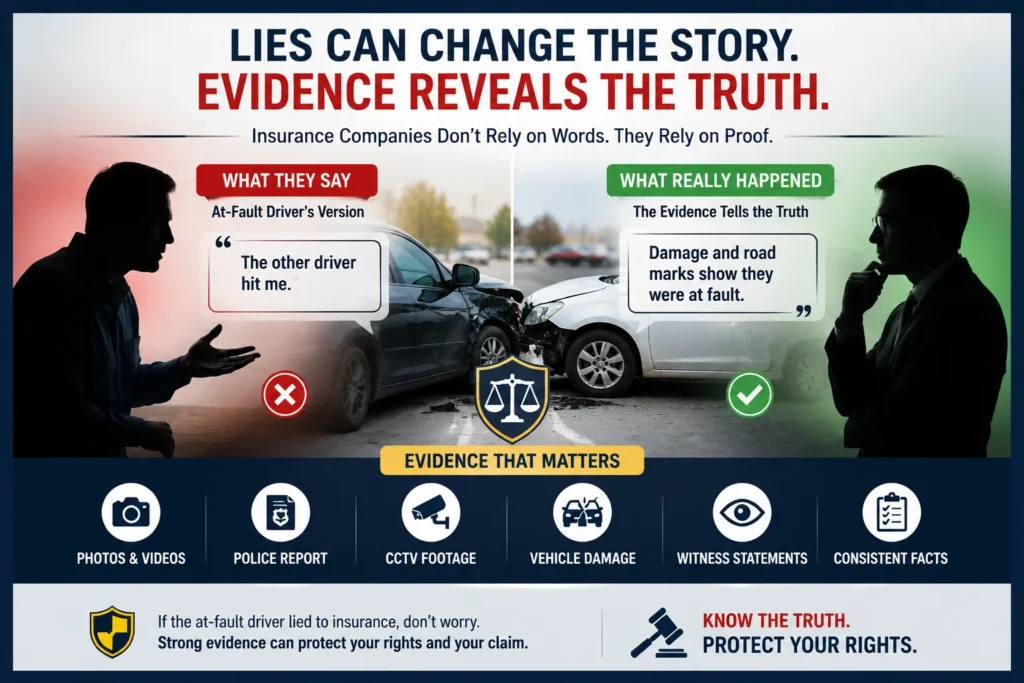
When at fault driver lied to insurance, insurance companies don’t argue with stories. They compare stories with reality.
And reality comes from evidence.
They look at:
- Vehicle damage direction
- Scratches, dents, paint transfer
- Exact impact points
- Road position of vehicles
- Police report details
- Photos and videos
And here is the key point:
If the story does not match the damage, the story loses power.
Even a very confident false statement cannot stand against physical proof.
Can Someone be Wrongly Accused of a Car Accident?
Yes, and it happens more than people expect.
Wrongly accused of car accident situations usually happen when:
- There is no dashcam
- No witnesses are available
- Both drivers give opposite stories
Then insurance tries to “best guess” fault using limited information.
That can sometimes lead to:
- Partial blame on the wrong driver
- Delayed claim approval
- Stress and confusion
But this is not final. Insurance decisions can change when better proof comes later.
How Fault is Actually Proven (Simple Explanation)
Proving fault in a car accident is not about who speaks better. It is about what the accident physically shows.
What really matters:
- Direction of damage (who hit from where)
- Car positioning after impact
- Brake marks or road signs
- Consistency of story over time
- Independent witness statements
Strong Proof Examples:
- Dashcam footage (very powerful)
- CCTV cameras nearby
- Traffic light cameras
- Clear accident photos
When all of this lines up, even if someone lies, the truth becomes very obvious.
What is a False Hit and Run Claim?
A false hit and run claim happens when one driver wrongly says the other:
- Ran away
- Left the scene
- Denied involvement
Sometimes it is confusion. Sometimes it is intentional.
But insurance and police usually verify through:
- CCTV footage
- Witness reports
- Vehicle tracking or location data
Most of these claims fall apart when real evidence is checked.
What to do If the Other Driver is Lying
When at fault driver lied to insurance, the most important thing is not panic. The second most important thing is documentation.
What helps most:
- Take photos from every angle
- Record damage clearly
- Collect witness contacts
- Get police report copy
- Submit everything fast to insurance
And very important:
- Stay consistent in your own story
- Do not change details later
Because in these cases, consistency is as important as evidence.
Can legal action be taken?
Yes, in certain cases.
Questions like can you sue someone for lying about a car accident depend on damage and proof.
Possible actions include:
- Insurance dispute request
- Claim review or appeal
- Civil case for compensation
- Fraud reporting in serious cases
But usually, insurance investigation is the first step before anything legal.
Common Mistakes that Make Things Worse
Many people unknowingly weaken their own case by:
- Not taking enough photos
- Leaving the scene too quickly
- Not getting witness details
- Admitting fault under pressure
- Delaying insurance report
These mistakes make it easier for false stories to spread.
Simple Way to Protect Yourself
The best protection is simple:
- Document everything immediately
- Don’t rely on memory later
- Let evidence speak, not emotions
- Stay calm at the scene
Because once at fault driver lied to insurance, the only thing that protects you is proof.
Conclusion
At fault driver lied to insurance situations are stressful, confusing, and sometimes unfair at first. But the system is not built on words alone. It is built on evidence.
So even if someone lies, the truth can still come out when damage, photos, witnesses, and records are properly used.
At the end of the day, proving fault in a car accident is not about who tells the better story, it is about what the accident actually shows.
Frequently Asked Questions
What should be done immediately if at fault driver lied to insurance?
If at fault driver lied to insurance, collect photos, videos, witness details, and police report immediately and send everything to insurance so the real facts are clearly supported.
Can you sue someone for lying about a car accident?
Yes, can you sue someone for lying about a car accident is possible if false statements caused financial loss, claim rejection, or proven fraud in the insurance process.
Why do driver statements of accident matter so much?
A driver statement of accident is important because it is the first version insurance compares with physical evidence to decide what really happened.
What happens if wrongly accused of car accident fault?
If wrongly accused of car accident, insurance may temporarily assign blame, but it can be corrected later with strong evidence like videos or witnesses.
How is proving fault in a car accident actually done?
Proving fault in a car accident is done by matching damage patterns, road position, witness statements, and video evidence to reconstruct the accident clearly.
What is a false hit and run claim?
A false hit and run claim happens when someone wrongly says the other driver fled the scene, and it is verified using CCTV or witness confirmation.
What if both drivers tell different stories?
If both drivers give different stories, insurance relies more on physical evidence than statements to decide fault.
Do witnesses really help in accident cases?
Yes, witnesses are very important because they give an outside view that helps confirm what really happened when at fault driver lied to insurance.
Can insurance reject a claim if someone lies?
Yes, insurance can reject or reduce a claim if intentional lying is proven during investigation.
How long do these cases usually take?
These cases usually take a few days to a few weeks depending on evidence, complexity, and investigation depth.