Getting into a car accident? It’s no joke. One minute you’re cruising along, everything’s fine. The next thing you know? You’re hurt, your car’s messed up, and your phone won’t stop ringing with insurance people. Then their medical bills start piling up quickly. And you’re just sitting there thinking, “Who’s gonna pay for all this?”
In New Jersey, the answer depends on a legal rule called modified comparative negligence.
The Rule in Simple Terms for comparative negligence
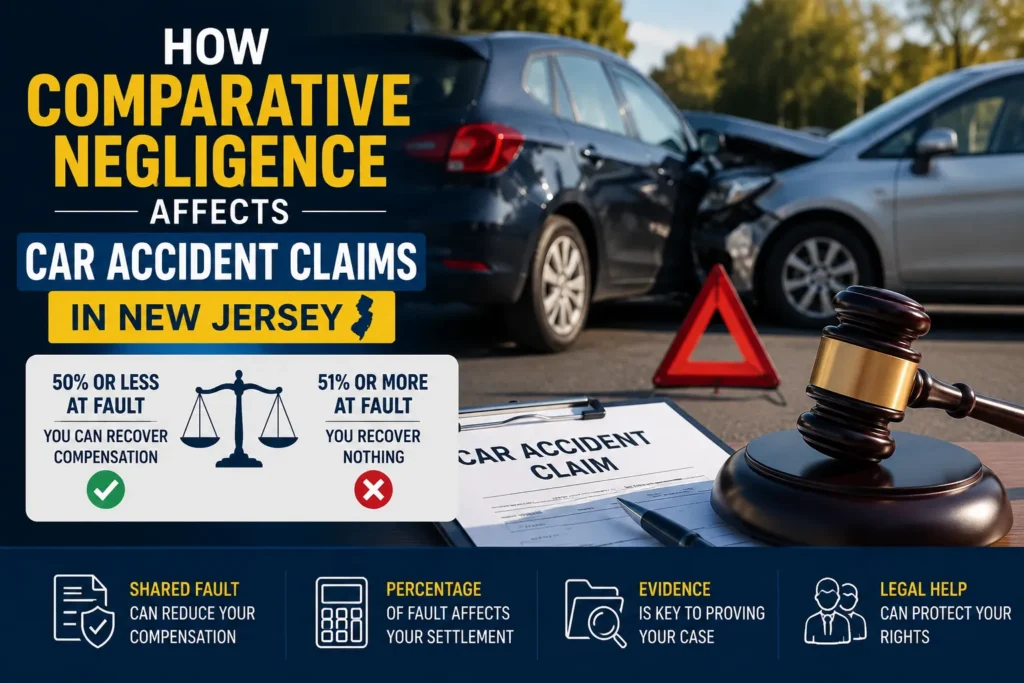
New Jersey follows what is called modified comparative negligence law. Here is the bottom line:
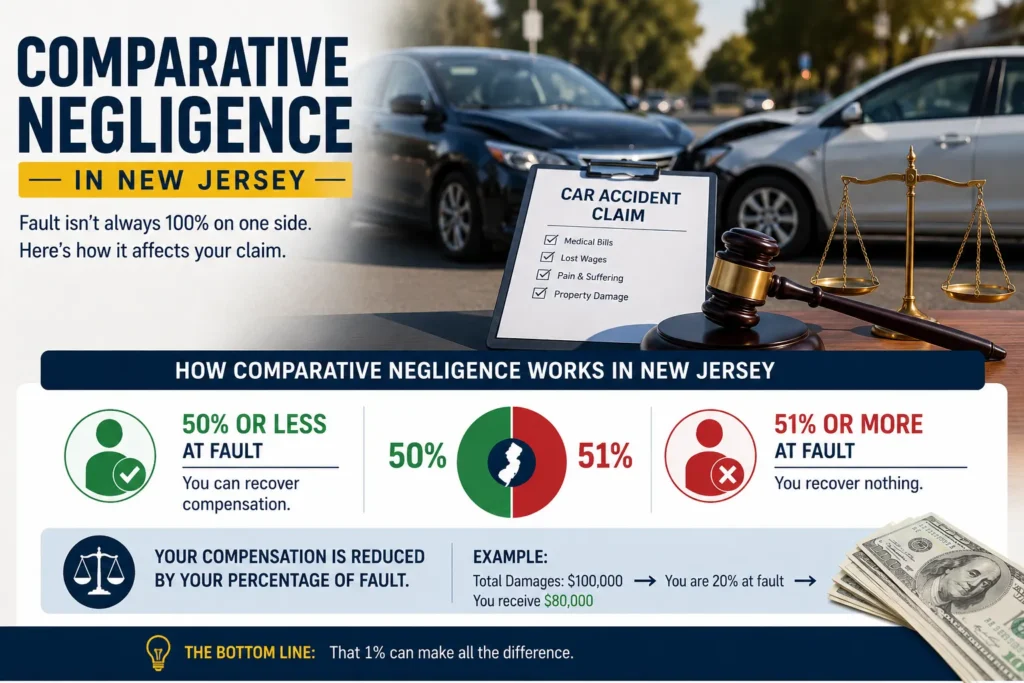
- If you are 50% or less at fault, you can still get compensation
- If you are 51% or more at fault, you get nothing
- Your payout gets reduced by your percentage of fault
That is it. That one rule decides whether you walk away with money or walk away empty-handed or partially at fault car accident.
How the Numbers Work in Shared Fault car accident
Let us make this real with an example. Say your total damages come to $100,000. That covers your medical treatment, lost wages, and pain and suffering. The insurance company investigates and says you were 20% at fault. The other driver gets 80%. You would receive $80,000. They simply subtract your 20% share.
Now imagine they say you were 51% at fault. You get zero. Even though the other driver was 49% at fault, you are out of luck. That one percent can cost you everything. Insurance companies know this. They try to push your fault percentage higher so they pay less for comparative fault car accident claims.
How proving fault in a New Jersey car accident determined
You might wonder how proving fault in a New Jersey car accident is determined. They look at evidence. Police reports are a big part of it. The officer at the scene writes down what they observe. It matters, but it is not the final word.
Witness statements can change everything. Someone who saw the crash might tell a different story than the drivers. Independent witnesses are gold. Photos and videos are game-changers. Almost everyone has a smartphone now. Dashcams are everywhere. Video footage can settle arguments fast. Save any footage you have.
Cars also have black boxes that record speed, braking, and steering before a crash. This data is hard to argue with comparative negligence. The insurance adjuster reviews all this and assigns fault percentages. If you disagree, you can challenge them.
Common Scenarios Where Fault Gets Shared
Fault is rarely 100% on one person. Here are some everyday situations where both drivers share blame on car accident fault laws.
In rear-end collisions, the driver in back is usually at fault. But if the front driver slammed on their brakes for no reason, some fault might shift forward.
In left-turn accidents, the turning driver typically has to yield. But if the oncoming driver was speeding, some fault could land on them too.
Pedestrian accidents can involve shared fault too. If someone crosses outside a crosswalk, they might share some blame. But drivers still have to watch for people.
How Fault Affects Your Settlement
Your fault percentage directly reduces your settlement. Every dollar gets cut by your share of blame. Here is how it works with $50,000 in damages:
– 10% at fault = you get $45,000
– 30% at fault = you get $35,000
– 50% at fault = you get $25,000
– 51% at fault = you get nothing
That math applies to medical bills, lost wages, and pain and suffering. There is one exception. New Jersey has no-fault insurance for medical bills. Your own insurance pays through Personal Injury Protection, or PIP, no matter who caused the crash. But once those bills exceed your PIP limits, comparative negligence kicks in.
What to Do If You Disagree with the Fault Decision
Disputes happen all the time. You might think you were 10% at fault while the insurer says 40%. Do not just accept it for comparative negligence. First, gather all your evidence. Photos, witness names, and copies of the police report. The more you have, the stronger your case.
Second, be careful what you say to the other driver’s insurance company. Adjusters are trained to ask questions that make you sound more at fault. You do not have to give a recorded statement.
Third, consider getting a lawyer. An experienced injury attorney can challenge unfair fault percentages and negotiate with the insurer. They know the tactics insurance companies use for comparative negligence.
Frequently Asked Questions
What is comparative negligence in New Jersey?
comparative negligence is a rule that splits fault between everyone in an accident. New Jersey uses a modified version where you can recover damages only if you are 50% or less at fault. Your award gets reduced by your fault percentage, and 51% or more means you get nothing.
Can I still get money if I was partially at fault?
Yes, as long as your fault is 50% or below. Your payout is reduced by your percentage of blame. For example, if your damages are $60,000 and you are 25% at fault, you receive $45,000.
How does the 51% rule work?
It is a hard cutoff. If you are 51% at fault, your claim is dead. Even if the other driver was 49% at fault, you get nothing. That one percent makes all the difference.
How do insurance companies decide fault?
They review police reports, witness statements, photos, videos, and black box data. The adjuster assigns percentages based on all the evidence. You can challenge their decision.
Can I fight a police report that blames me?
Absolutely. A police report is just an officer’s opinion, not a final ruling. You can present photos, witness accounts, or other evidence that tells a different story.
Can fault be split between more than two drivers?
Yeah, especially in pileups. Fault gets divided up among everybody involved, and all the percentages have to add up to 100%. As long as your share is 50% or less, you can still get compensated.
What if I disagree with the insurance company’s fault decision?
You can ask for an internal appeal. If that doesn’t work, you can contact the Office of the Insurance Ombudsman. And if all else fails? You can take it to court.
Does this rule apply to pedestrian accidents?
Yep, it applies to everybody. If a pedestrian jaywalks or ignores traffic signals, they can share some of the blame. But they can still recover damages as long as their fault is 50% or less.
How long do I have to file a claim?
In New Jersey, you got two years from the date of the accident to file a lawsuit. Miss that deadline? You lose your right to compensation. Permanently.
Can a lawyer help if fault is disputed?
Absolutely. They often make a big difference. A good lawyer knows how to gather evidence, challenge unfair fault percentages, and negotiate with insurance companies. They know all the tricks insurers try to pull, and they know how to fight back.