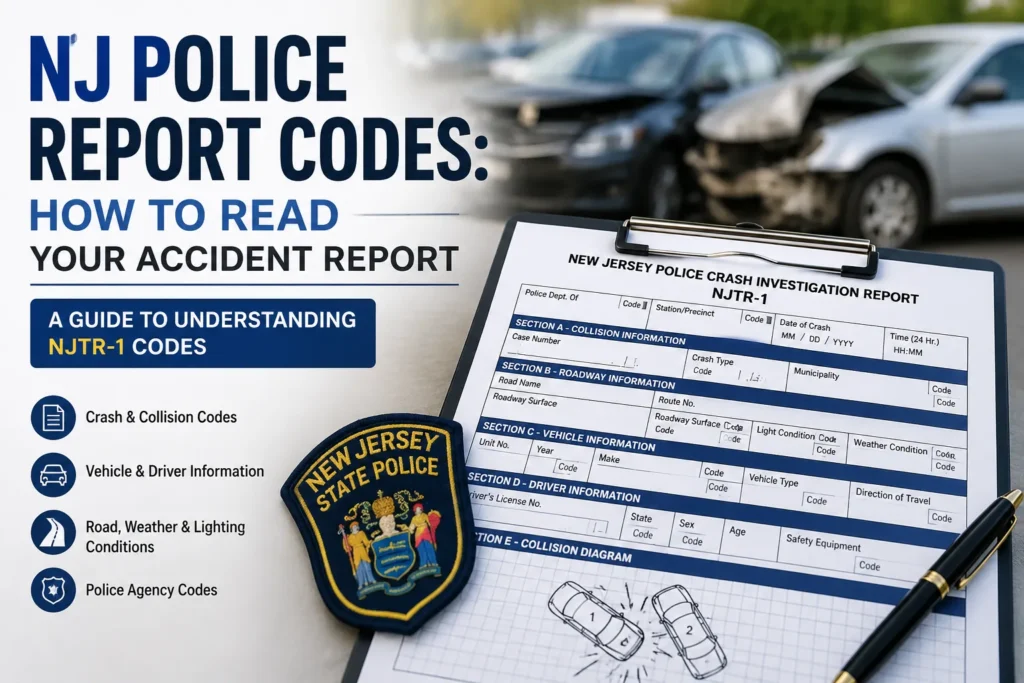
The NJ police report codes could be challenging to understand since they may contain many numbers, abbreviations, boxes, and even some codes with crucial details. If you recently received a police accident report in New Jersey, you may wonder what the numbers, abbreviations, and codes on the report mean.
The official NJTR-1 is the NJ Crash Investigation Report for documenting investigated crashes.
What Are NJ Police Report Codes?
NJ police report codes are abbreviations and numeric designations that provide information about the accident report in New Jersey.They classify the police agency, roadway, vehicles, drivers, and crash information.
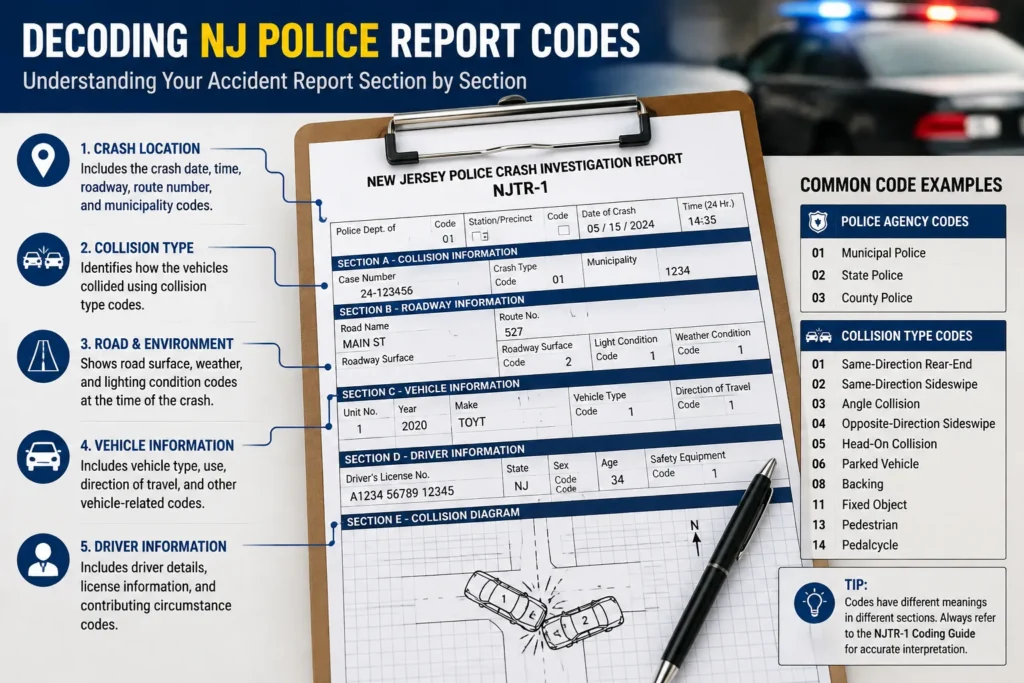
For instance, police agencies are often abbreviated as 01 for municipal police, 02 for the state police, and 03 for county police.These codes help organize and identify important information throughout the police report.
Common NJ Police Report Codes and Their Meanings
The meaning of a code depends on the section of the NJTR-1 report where it appears. For clarity, police agency codes and collision type codes should be listed separately.
Police Agency Codes
| Code | Meaning |
| 01 | Municipal police |
| 02 | State police |
| 03 | County police |
Collision Type Codes
| Code | Meaning |
| 01 | Same-direction rear-end collision |
| 02 | Same-direction sideswipe |
| 03 | Angle collision |
| 04 | Opposite-direction sideswipe |
| 05 | Head-on collision |
| 06 | Parked vehicle |
| 08 | Backing |
| 11 | Fixed object |
| 13 | Pedestrian |
| 14 | Pedalcycle |
Important: NJTR-1 codes are section-specific, so the same number may have a different meaning in another part of the report. Always refer to the applicable NJTR-1 coding guide when interpreting a code.
How to Read Police Report Codes NJ
The best way to read NJ police report codes is to focus on one section or paragraph at a time. Start with some of the most fundamental details about a crash before analyzing the other sections of the report.
1. Check the Crash Location
Review the crash location, date, time, roadway, and municipality to determine where and when the accident occurred. The New Jersey Police Crash Report also provides roadway and route codes for Alternate, Business, Freeway, and Spur routes.
2. Identify the Collision Type
One of the most informative parts of NJ crash report codes is the collision type. The information describes how the vehicles involved in the crash collided with one another . The report may also identify crashes involving sideswipes, angled impacts, rear-end collisions, and other types of crashes.
Understanding New Jersey Police Report Codes for Road Conditions
Review the road and environmental information about the weather, road surface, and lighting conditions to get an idea of the environment during the time of the collision. Road surface codes may indicate conditions such as dry, wet, snow-covered, icy, unknown, or other surfaces. The lighting category includes daylight, dark, dawn, dusk, and other options.
Review Vehicle and Driver Information
After analyzing the details about the crash and the environment, you can review the sections that provide information about the vehicles and drivers. Pay close attention to the vehicle or driver identification, direction, use, and circumstances.
For instance, when there are two cars mentioned in a report, one can compare the information on Vehicle 1 and Vehicle 2 to identify inconsistencies. If one of the cars was going straight while the other one turned, this information can be useful in conjunction with the police report.
NJ Accident Report vs. Self-Reported Crash Form
It’s crucial to recognize the difference between a police crash report and a self-reported accident form. The NJTR-1 is for police-investigated crashes, while New Jersey’s SR-1 is a self-reporting crash form for documentation when a crash isn’t investigated by police.
How to Read a Police Accident Report Correctly
When learning how to read a police accident report, avoid interpreting any single code on its own. You should always review an entire section and how it applies to the whole report. For example, looking at a collision code can help you identify what type of crash occurred, but the diagrams and narrative are also essential for understanding the details.
If you’re reviewing an NJ accident report for insurance or legal purposes, it’s a good idea to have a qualified professional analyze any unclear codes and circumstances instead of guessing what they might mean.
Why NJ Police Report Codes Matter
Understanding police report codes NJ can make reading a crash report much simpler. The codes make it easier to identify specific information about a crash, while the standardized format lets law enforcement document incidents uniformly with the same numbers and sections.
Conclusion
First of all, become acquainted with the standard NJTR-1 report format.Focus first on such simple details as the collision location and date, as well as other obvious circumstances.
Study the report in detail to obtain information about the vehicles involved, drivers, road, weather, and lighting conditions. Finally, if you feel confused while reading a particular report, turn to a professional who will help you understand each symbol and code.
Frequently Asked Questions
What are NJ police report codes?
NJ police report codes are the numbers and abbreviations used for documenting information regarding an accident, including the crash details, vehicles, people, roadway, and other relevant information.
What is an NJTR-1 report?
NJTR-1 reports are the official New Jersey Police Crash Investigation Report for investigated accidents.
What do NJ crash report codes tell me?
They can help specify the details of a crash, for example, type of collision, road surface, lighting, police district, vehicle information, and more.
How can I learn how to read police report codes in NJ?
First, determine which box or section of a report the code belongs to, then cross-reference the code with the appropriate NJDOT NJTR-1 guide.
Are New Jersey police report codes the same on every document?
Since police report forms can vary, it’s critical to follow the most up to date coding documentation for reports, such as the NJTR-1 report manual.
Is an NJ accident report the same as an SR-1?
Not exactly. An NJ accident report such as the NJTR-1 is different from an SR-1 because the former is a police crash report, whereas the latter is a self-reported accident form for crashes not investigated by police.
Can a crash code alone determine who was at fault?
No, a code alone isn’t sufficient for identifying the cause of a crash or determining at-fault status. It’s important to take the whole report, diagram, narrative, evidence, and other circumstances into account when analyzing a police report.