Settlement outside of court is usually the first thing that comes up when a personal injury claim starts moving in New Jersey. Most people do not realize how often cases end without ever seeing a courtroom. In real situations, settle out of court becomes the normal path, not the exception.
After an accident, everything feels uncertain. Medical bills start stacking up, work gets affected, and insurance companies begin their own process. At that point, settlement outside of court often becomes the fastest way to bring some control back into the situation.
Instead of waiting for a trial that can take months or even years, both sides try to agree on an amount. That is where settlement outside of court plays its biggest role. It turns a stressful legal fight into a negotiated resolution.
What Settlement Outside of Court Really Means?
In New Jersey personal injury claims, settlement outside of court simply means both sides agree on compensation without a judge deciding the outcome.
It usually happens through negotiation between lawyers and insurance companies.
- No courtroom trial involved
- No jury decision
- Agreement reached privately
- Compensation paid based on negotiation
Most accident claim without court situations are handled exactly this way. It is not unusual, it is actually the standard path.
When people hear settlement outside of court, it often sounds complicated, but in reality, it is just a discussion that leads to an agreement.
Why Settlement Outside of Court Happens so Often?
There is a simple reason why settlement out of court is used so widely in New Jersey injury cases: it saves time and reduces risk for everyone involved.
Insurance companies do not want unpredictable jury outcomes. Injured people do not want long waiting periods. Lawyers usually prefer a clean resolution when possible.
- Trials are expensive and slow
- Outcomes are uncertain in court
- Negotiation gives control back to both sides
- Medical recovery cannot wait for court dates
That is why settlement outside of court becomes the practical solution in most claims.
Even complex injury cases often end in settlement outside of court once both sides understand the risks of going further.
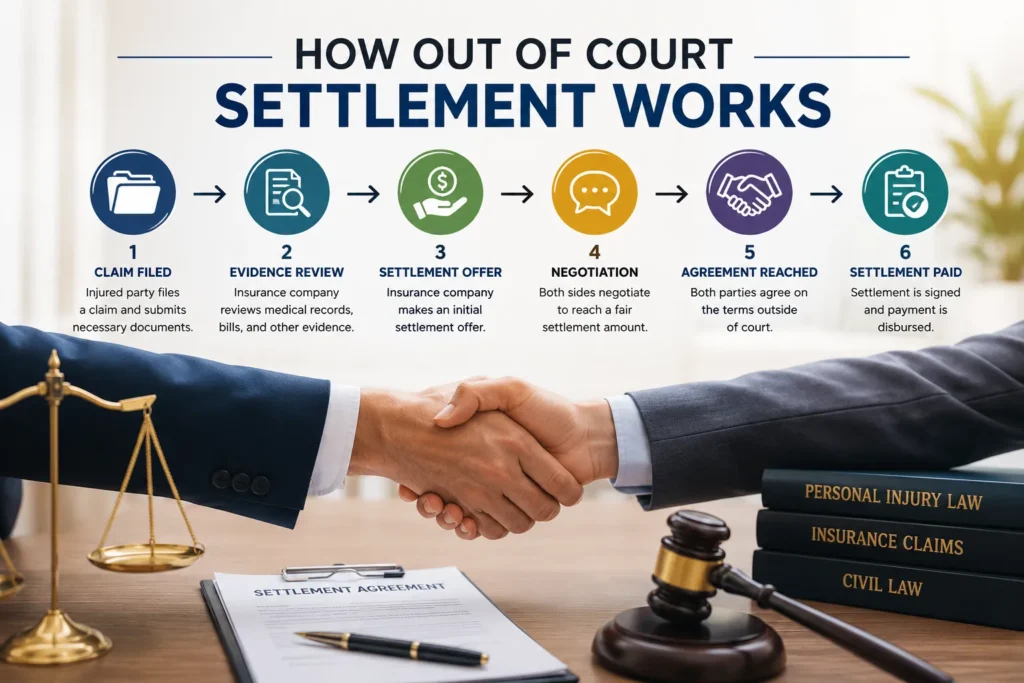
How Settlement Outside of Court Actually Works Step by Step
Most people think it is one simple conversation, but settlement outside of court usually follows a clear process.
Step 1: Claim is filed
- Medical records and accident details are collected
- Insurance company is notified
Step 2: Evidence is reviewed
- Bills, reports, and loss of income are checked
- Fault is discussed
Step 3: First offer comes in
- Insurance company usually starts low
- This is normal in settlement outside of court
Step 4: Negotiation continues
- Both sides go back and forth
- Numbers slowly adjust
Step 5: Final agreement
- Once both agree, settlement outside of court is finalized
- Payment terms are signed
At any stage, settlement outside of court can either move forward or break down depending on agreement.
Why People Prefer Settlement Outside of Court in New Jersey
There is a very human reason behind it. After an accident, most people just want closure.
Faster resolution
- No waiting for trial dates
- Settlement outside of court often resolves faster
Less stress
- No courtroom pressure
- No public testimony
More control
- Both sides negotiate instead of a judge deciding everything
Financial stability
- Medical bills can be paid sooner
- Lost wages recovered earlier
That is why settlement outside of court becomes the practical choice in most injury cases.
The Advantages of Settlement Outside of Court
When looking at real outcomes, settlement outside of court brings several clear benefits.
- Faster access to compensation
- Lower legal costs overall
- Less emotional pressure
- Private resolution instead of public trial
- More predictable outcome
In many cases, settlement outside of court helps avoid the uncertainty of jury decisions.
Even strong cases sometimes prefer settlement outside of court simply to avoid delays.
The Out of Court Settlement Disadvantages
Even though settlement outside of court is common, it is not always perfect.
Possible downsides
- Settlement might be lower than expected trial value
- Insurance companies may push early offers
- Long-term injuries can be underestimated
- No jury review of the claim
What this really means in practice
- Fast money sometimes comes with compromise
- Pressure can influence decision-making
- Future medical costs may be hard to calculate
So while settlement outside of court is helpful, it is not always the highest-paying option.
Common Misunderstandings About Out-of-Court Settlements
Many people wonder whether an out-of-court settlement is legal. In New Jersey, resolving a claim outside the courtroom is completely legal when both parties properly document the agreement.
Another misunderstanding is the belief that accepting a settlement outside of court means losing important legal rights. In reality, the process simply allows both sides to agree on fair compensation without going through a trial.
Some individuals also assume that settling an injury claim outside of court means the case is weak. In many situations, both parties choose settlement because it offers more certainty, saves time, and reduces the risks associated with a courtroom trial.
When Settlement Outside of Court Makes the Most Sense
Settlement outside of court usually works best when:
- Liability is clear
- Medical records are strong
- Insurance company is willing to negotiate
- Both sides want quick resolution
In these situations, settlement outside of court becomes the natural path forward.
However, if fault is heavily disputed or injuries are severe, the decision becomes more strategic.
Real-life Flow of Settlement Outside of Court in Injury Claims
To understand it better, think of how most cases actually move:
- Accident happens
- Medical treatment begins
- Insurance claim is filed
- Negotiation starts
- Settlement outside of court is reached
This flow is extremely common in out of court settlement personal injury system.
Most people never actually step inside a courtroom because settlement outside of court resolves things earlier
Key Things to Remember Before Agreeing
Before accepting settlement outside of court, a few important things usually matter:
- All medical bills are included
- Future treatment costs are considered
- Lost wages are properly calculated
- Final agreement is clearly written
Once settlement outside of court is signed, the case is usually closed permanently.
That is why reviewing everything carefully matters a lot.
Conclusion:
settlement outside of court is not just a legal option in New Jersey personal injury cases, it is the most common way these claims end.
It brings speed, reduces stress, and avoids court delays. At the same time, it requires careful attention so compensation is fair and complete.
Understanding how settlement outside of court works makes it easier to settle injury claim without court.
Frequently Asked Questions
Is settlement outside of court common in New Jersey personal injury cases?
Yes, most personal injury cases in New Jersey are resolved through settlement outside of court instead of going to trial because it saves time, reduces cost, and avoids long legal delays.
How long does settlement outside of court usually take?
It can take anywhere from a few weeks to several months depending on medical treatment, insurance response time, and how quickly both sides agree during negotiation.
Does settlement outside of court mean accepting less money?
Not always. Sometimes it is lower than trial value, but it also removes risk, legal delays, and uncertainty that come with court decisions.
Can settlement outside of court be rejected?
Yes, any offer can be rejected if it does not properly cover medical costs, lost income, or long-term injury impact, and negotiation can continue.
Is out of court settlement legally valid in New Jersey?
Yes, it is fully legal as long as both sides agree voluntarily and sign a written agreement that clearly explains compensation terms.
Do insurance companies prefer settlement outside of court?
Yes, insurance companies usually prefer settlement outside of court because it helps them avoid trial costs and unpredictable jury decisions.
What happens if settlement outside of court fails?
If no agreement is reached, the case can move forward to court where a judge or jury will decide the outcome after trial proceedings.
Can future medical expenses be included?
Yes, future treatment costs can be included if properly documented and supported by medical evidence during settlement discussions.
Do most cases still go to trial?
No, most cases end through settlement outside of court before reaching trial because both sides usually prefer negotiation over litigation.
Should settlement be accepted quickly?
No, rushing can lead to lower compensation. It is important to evaluate medical costs, long-term impact, and negotiate properly before final agreement.