Can you sue after signing a waiver is the kind of question that usually hits the moment something goes wrong, not when the paper is actually signed. At the time of signing, most people just glance over it, sign it quickly, and move on. But later, when an injury happens, that same document suddenly feels like the biggest barrier in the world.
In New Jersey, the reality is more balanced than most people assume. A signed waiver does not automatically shut everything down. It does not mean all legal rights disappear. And it definitely does not give a business unlimited freedom to act carelessly.
Everything comes down to what actually caused the injury and how responsibly the situation was handled.
What a Liability Waiver is Really Doing?
A waiver is basically a warning plus agreement combined into one document.
It is saying:
This activity has risks, and participation is happening with awareness of those risks
But what it is NOT saying is just as important:
- It is not saying safety rules can be ignored
- It is not saying negligence becomes acceptable
- It is not saying responsibility is completely removed
So when asking for a personal injury claim after signing a waiver, the answer always depends on what kind of harm happened and why it happened.
Can you Sue After Signing a Waiver When Something goes Wrong?
It depends heavily on the cause behind the injury.
If the situation was a normal expected accident, like slipping during sports or getting minor injury during a physical activity, the waiver usually carries strong weight.
But when something goes beyond normal risk, the situation changes.
Legal action may still be possible when:
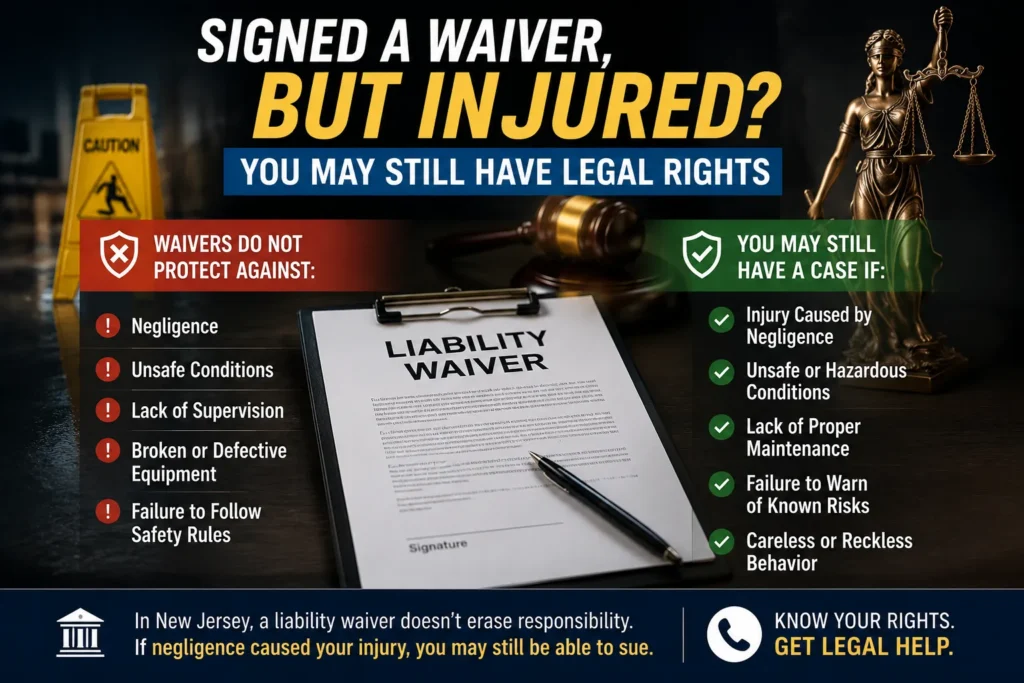
- Equipment was broken or unsafe and nobody fixed it
- Staff failed to follow basic safety steps
- Warnings were not given even when danger was known
- Supervision was missing where it clearly should have been there
- Conditions were unsafe and ignored for too long
In these situations, waiver of liability becomes very real again because responsibility still exists.
The Biggest Misunderstanding about Signing Waiver
Most people think signing waiver means everything is blocked forever. That is not how courts see it.
A waiver mainly covers expected risks of an activity, not careless behavior.
So even after signing waiver:
- Basic duty of care still exists
- Safety responsibility still exists
- Reasonable protection still has to be provided
That is why can you sue after signing a waiver is still a valid legal question in many injury cases.
Suing for Negligence After Signing a Waiver Explained Simply
Suing for negligence after signing a waiver usually becomes the turning point in most cases.
Negligence basically means something preventable was ignored or handled poorly.
Some real-life situations where negligence matters:
- Equipment that should have been repaired but was left broken
- Unsafe environment that was already known but not fixed
- Lack of proper supervision during risky activity
- Staff acting without proper training or care
- Safety rules not being followed properly
When this kind of failure is proven, can you sue after signing a waiver often becomes yes, because waivers do not protect against careless behavior.
How New Jersey Courts Actually Look at these Cases
Courts do not just look at the signature. They look at fairness and responsibility.
They usually ask:
- Was the waiver written clearly enough to understand
- Did the person actually know what they were agreeing to
- Was the risk something normal or something avoidable
- Did the business act responsibly or carelessly
If something feels unfair or unclear, the waiver becomes weaker in court.
So can you sue after signing a waiver often depends on how strong the facts are, not just the paper.
When Waiver Usually does Protect the Business
To be fair, waivers do work in many normal situations.
A waiver is more likely to hold when:
- The injury is part of the natural activity risk
- There is no proof of negligence
- Safety procedures were properly followed
- Everything was reasonably maintained and managed
In these cases, can you sue after signing a waiver becomes very difficult.
Liability Waiver Laws
Liability waiver laws in New Jersey try to keep balance.
On one side:
- Businesses should not be blamed for every small accident
On the other side:
- People should not be exposed to unsafe or careless environments
So the law allows waivers, but only up to a point.
They do not protect against negligence or unsafe conduct.
That is the core idea behind can you sue after signing a waiver.
What a liability waiver lawsuit actually focuses on
A liability waiver lawsuit usually does not start and end with the waiver.
It looks deeper:
- What exactly happened
- How the injury happened
- Whether safety rules were followed
- Whether the risk was preventable
- Whether negligence played a role
If negligence is proven, the waiver often loses its full protection.
So can you sue after signing a waiver becomes a question of proof, not just paperwork.
Quick comparison
| Situation | What usually happens |
| Normal activity accident | Waiver usually applies |
| Expected physical risk | Usually limited claim |
| Unsafe equipment | Claim may still be possible |
| Negligence involved | Strong chance of case |
| Reckless behavior | Very strong legal case |
Conclusion:
Can you sue after signing a waiver is not a fixed yes or no answer. It depends on what caused the injury and whether proper care was taken.
A waiver can reduce liability, but it cannot erase responsibility when negligence is involved.
Frequently Asked Questions
Can you sue after signing a waiver if injury happens during sports?
Yes, if the injury was caused by unsafe conditions, poor supervision, or negligence, legal action may still be possible even after signing waiver.
Does signing waiver remove all legal rights?
No, signing waiver does not remove all rights. It mainly limits claims related to normal and expected risks, not negligence.
What is liability waiver?
A liability waiver is an agreement where a person accepts known risks of an activity, but it does not remove a business’s duty to act safely.
Can a waiver be ignored in court?
Yes, courts can reduce or reject a waiver if it is unclear, unfair, or if negligence caused the injury.
Can you sue after signing a waiver in gym injury cases?
Yes, especially when equipment failure, unsafe conditions, or lack of supervision is involved.
What does suing for negligence after signing a waiver mean?
It means taking legal action because the injury happened due to careless or unsafe actions, not just normal risk.
Do all waivers protect businesses fully?
No, waivers do not provide full protection, especially when safety responsibilities are ignored.
Why do courts still allow cases after waiver?
Because public safety and responsibility cannot be completely removed through a signed document.
What is the most important factor in waiver cases?
The most important factor is whether negligence or unsafe behavior caused the injury.
Why can you sue after signing a waiver?
Because many people realize only after an accident that waivers do not always block legal claims when something was preventable.