
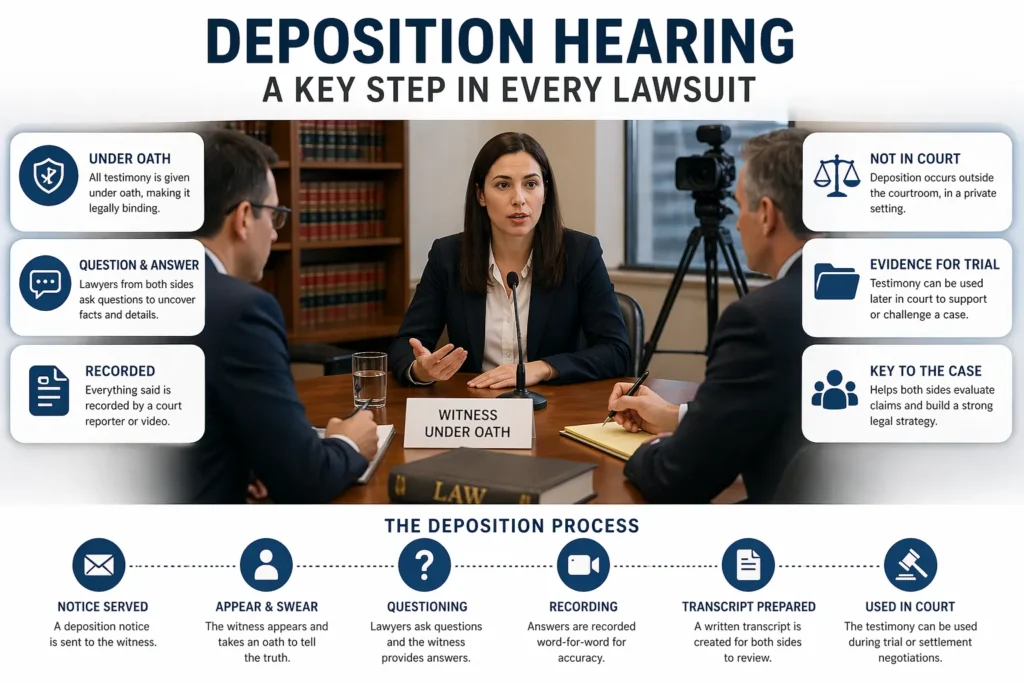
Deposition hearing is one of the most important parts of a lawsuit where everything becomes real, detailed, and officially recorded before the case ever reaches a courtroom. Deposition hearing is basically a formal question and answer session where witnesses or parties give sworn testimony outside court.
Now here is the simple way to understand it. A deposition hearing is where lawyers sit down and ask questions to find out exactly what happened, without a judge present, but still under oath. That means every answer matters and every word can later be used in trial.
A deposition hearing is not about arguing or deciding who wins. It is about collecting truth, checking consistency, and building the full picture of the case.
Most people only hear about court trials, but in reality, a deposition hearing is where a lot of the real case work actually gets shaped.
What is Deposition Hearing in Simple Law Terms
A deposition hearing is a legal step where a person gives sworn answers outside of court during a lawsuit. It happens during the discovery phase, which is the stage where both sides are still gathering information.
Think of it like this. Instead of waiting for trial to ask questions, lawyers bring everything forward and do it in detail during a deposition hearing.
What makes a deposition hearing important
- Everything is under oath
- Answers are recorded word for word
- Lawyers from both sides are present
- It becomes part of legal evidence
- It can be used in trial later
A deposition hearing is basically a way to lock in testimony early so nobody can change their story later.
How Deposition Hearing Works in Real Life
A deposition hearing follows a structured flow, but the way it feels is like a long, detailed conversation under pressure.
Here is how it actually goes step by step.
Step by Step process
- A notice is given for deposition hearing
- Witness arrives or joins online
- Oath is taken to tell the truth
- Lawyer starts asking questions
- Opposing lawyer follows up
- Breaks can be taken if needed
- Everything gets recorded
During a deposition hearing, questions are not random. They are planned to slowly build a full understanding of what happened.
So what actually happens is this. One lawyer asks something simple, then slowly moves deeper into details to check if the story stays consistent.
A deposition hearing often feels long because lawyers go into timelines, actions, documents, and even small details that matter later.
Timeline of Deposition Hearing in a Lawsuit
A deposition hearing does not happen at the beginning of a case. It comes after the lawsuit is filed and after basic documents are exchanged.
Simple lawsuit flow
- Case is filed
- Discovery phase begins
- Evidence is shared
- Deposition hearing takes place
- Lawyers review everything
- Settlement or trial preparation starts
A deposition hearing usually happens when both sides already know the basic facts but want clarity on deeper details.
Depending on the case, a deposition hearing may happen once or multiple times if there are several witnesses.
What Happens During Deposition Hearing
A deposition hearing is very structured but still feels like a long interview under oath.
Here is what usually happens inside it:
- Personal background questions first
- Event related questions next
- Detailed follow up questioning
- Clarification of earlier statements
- Review of documents if needed
A deposition hearing is not about tricking anyone. It is about checking facts and making sure everything lines up with evidence.
Lawyers listen carefully during a deposition hearing because even small contradictions can change how strong a case looks.
What Happens After Deposition Hearing
After a deposition hearing, things start moving in a more serious direction.
Now both sides already know what the witness said, so the focus shifts to strategy.
What usually comes next
- Lawyers review transcript
- Evidence is compared with testimony
- Settlement talks begin
- Case strategy is adjusted
- Trial preparation continues
A deposition hearing often becomes the point where cases either settle or move closer to trial.
Here is the key thing. Once a deposition hearing is done, surprises become less likely because everything is already recorded and analyzed.
Personal Injury Deposition Hearing
In personal injury cases, a deposition hearing becomes even more important because it directly connects to compensation and medical proof.
What gets discussed
- How the accident happened
- Medical treatment history
- Pain levels and recovery
- Work impact and income loss
- Daily life changes
A deposition hearing in personal injury cases is where the injured person explains their full experience in detail.
Insurance companies pay very close attention to a deposition hearing because it helps them decide settlement value.
If the deposition hearing is strong and consistent, settlement chances increase. If there are gaps, the case may weaken.
What is Next Step After Deposition Hearing
Once a deposition hearing is finished, the lawsuit enters a decision phase.
Now lawyers are not just collecting information anymore. They are deciding what to do with it.
Possible next steps
- Settlement negotiations
- Mediation sessions
- Additional witness statements
- Trial preparation
A deposition hearing usually helps both sides understand risk more clearly.
So what happens next is simple. If both sides feel uncertain about winning, they often settle. If not, they prepare for trial.
A deposition hearing is basically the point where the case direction becomes clearer.
Why Deposition Hearing Matters So Much
A deposition hearing is not just another legal step. It is where truth gets tested in detail.
Why it matters
- It locks testimony under oath
- It exposes inconsistencies
- It strengthens or weakens claims
- It shapes trial strategy
- It influences settlement value
A deposition hearing often shows how a witness behaves under pressure, which is very different from written statements.
That is why lawyers take a deposition hearing very seriously.
Simple Way to Understand Deposition Hearing
Here is the easiest way to think about it.
A deposition hearing is like a full rehearsal before the courtroom.
Everything is checked before the real trial starts. Nothing is left unclear.
A deposition hearing helps make sure that when the case reaches court, both sides already know what will be said.
Quick Flow of Deposition Hearing
- Case begins
- Discovery starts
- Documents exchanged
- Deposition hearing conducted
- Transcript prepared
- Settlement or trial follows
A deposition hearing connects investigation with final decision making.
Conclusion
A deposition hearing is one of the most important stages in a lawsuit because it brings real facts out under oath before trial. A deposition hearing helps lawyers understand truth, test credibility, and prepare strong legal strategies.
Once a deposition hearing is complete, the case usually moves toward settlement discussions or trial preparation depending on how strong the testimony is.
A deposition hearing is where the case becomes clear, structured, and ready for its final direction.
Frequently Asked Questions
What is deposition hearing?
A deposition hearing is a sworn question and answer session outside court where lawyers collect facts and record testimony for use in a lawsuit or trial.
How does deposition hearing actually work?
A deposition hearing works by placing a witness under oath, asking structured questions, recording answers, and preparing a transcript that becomes legal evidence later.
What happens after deposition hearing ends?
After a deposition hearing, lawyers review everything said, compare it with evidence, and then move toward settlement talks or trial preparation depending on case strength.
How long does deposition hearing take?
A deposition hearing can take from one hour to several hours depending on case complexity, number of questions, and how many details need to be covered.
Is deposition hearing same as court trial?
No, a deposition hearing is not a trial. It happens outside court, but testimony is still under oath and can be used later in the actual trial.
Why is deposition hearing important in personal injury cases?
A deposition hearing is important in personal injury cases because it explains accident details, medical treatment, and financial loss which affects compensation value.
What is next step after deposition hearing?
The next step after a deposition hearing is usually settlement negotiation, mediation, further discovery, or trial preparation depending on how strong the case appears.
Can deposition hearing statements be used in court?
Yes, everything said in a deposition hearing is recorded under oath and can be used in court to support or challenge statements during trial.