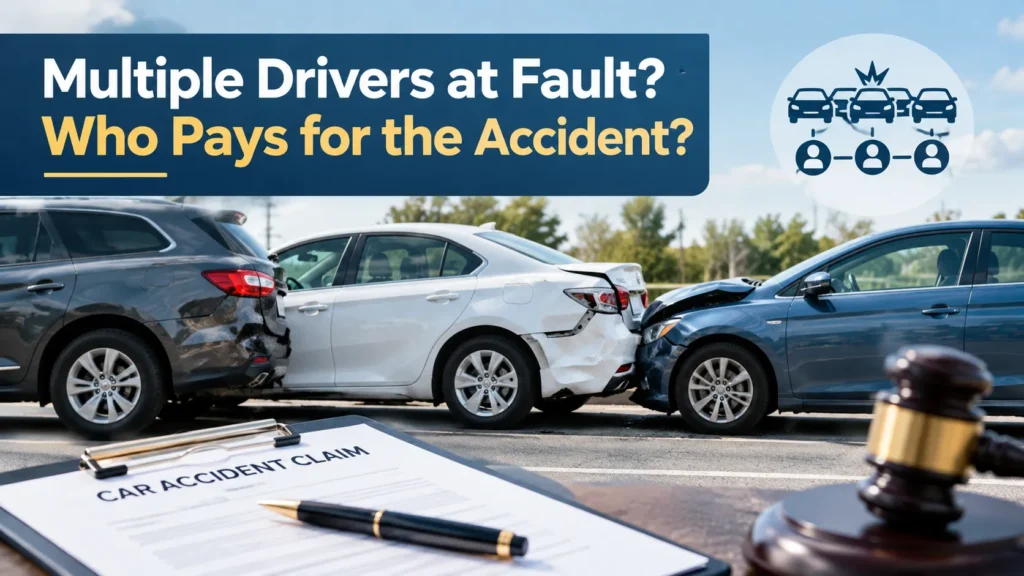
If there are several vehicles involved in an accident, determining who is responsible for the crash is not always easy. One of the drivers may follow too closely, a second may fail to check for other vehicles when changing lanes, and a third may not stop in time. In these situations, multiple drivers at fault in car accident claims can become complicated because responsibility may be shared among several people.
So, who is responsible for the damages? The answer will vary depending upon what each driver has done, the evidence available, insurance coverage and the laws of the state in which the accident took place.
Knowing about liability will help you safeguard your rights, deal with the insurance company and understand what one might expect when being part of a multi-vehicle accident settlement.
Who is at Fault in a Multi-Car Accident?
Determining who is at fault in a multi-car accident requires looking at how the collision happened, not simply counting the vehicles involved. A police report, witness statements, photos, traffic camera footage, and vehicle damage can all help establish how the collision occurred.
Suppose there are three vehicles in the middle of a busy road. The first driver suddenly slows down and the second driver follows too closely and slams into the first car, and the third driver, who was following too closely, slams into the second car.
The first driver might have played a role in the situation, but the second and third drivers also may be at fault for not leaving a safe space between them. Fault determination will be based on the circumstances of the case.
Common reasons of multiple drivers at fault in car accident may share responsibility include:
- Driving too close to other vehicles and/or too fast.
- Failure to change lanes with caution of blind spots.
- Taking your eyes off the road or inattention to traffic.
- Failure to stop at a red light or stop sign.
- Not stopping or taking steps to prevent a collision.
Who is Liable in a Multi-Car Accident?
Understanding who is liable in a multi-car accident starts with the difference between fault and liability. Fault is determined by who is at fault for the collision. The legal obligation to cover any losses incurred is called liability.
If multiple drivers at fault in car accident are involved in an accident, they may be liable for part of the damages. Their insurance companies tend to investigate and examine what their insured driver did.
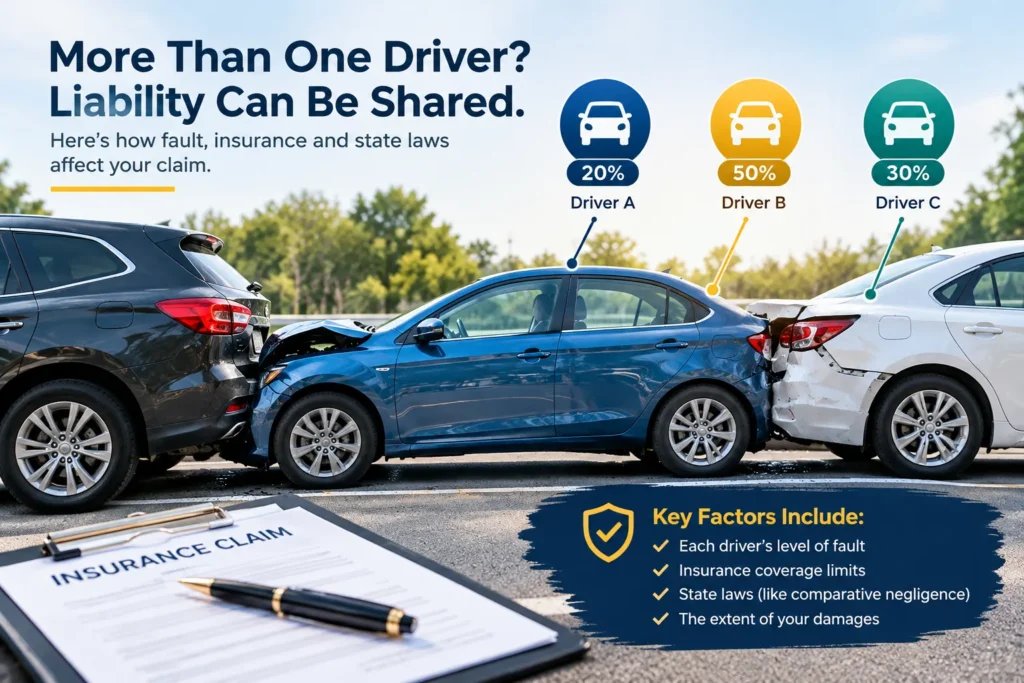
Let’s say there are three drivers that are involved in a collision:
- Driver A is determined to be 20% at fault.
- Driver B is deemed to be 50% at fault.
- The driver of the vehicle is 30% at fault.
The percentages show only a possible allocation of responsibility and are not a forecast of the results in a real claim. Those percentages impact recovery and payment in accordance with the applicable law.
Limits of insurance are also a factor. A driver may be held liable, but not necessarily his or her policy will provide coverage for all losses. In certain situations, injured individuals may have to look at their insurance coverage or other potential sources of compensation.
How Does Shared Fault in a Car Accident Affect Compensation?
Shared fault in a car accident means that more than one person contributed to the collision. Under comparative negligence laws, a person’s share of responsibility for a collision may affect the amount of compensation they can recover, although the rules vary by state.
Under these rules, a person’s damages can be reduced based on his/her degree of responsibility. But the specifics change from state to state. Under certain states’ laws, recovery is available where a party is only partly liable, but in others, it may be limited if the party’s liability exceeds a specific percentage.
For example, if your damages are $20,000, and you are 20% at fault, then a basic comparative-fault calculation would find out that $4,000, or 20%, of the damages is your fault and therefore, you would have $16,000 before any other issues of law or insurance.
This is an example only illustration. It does not set the amount that an insurer has to pay in any given instance, particularly where there are multiple defendants, policy limits and state-specific rules.
What Affects a Multi-Vehicle Accident Settlement?
A multi-vehicle accident settlement depends on more than the number of cars involved. Insurers and, if needed, a court will take into account the evidence of fault, the extent of the injuries, the cost of repairs, and the losses for which a claim is made.
Important factors include:
- Percentages for fault: Percent of fault each driver was at fault for.
- Medical expenses: Treatment costs and other eligible injury-related losses.
- Damage to the vehicle: Repairs or the vehicle’s total value if it is a total loss.
- Lost income: Financial losses due to the accident, including wages.
- Insurance limits: How much coverage is provided by the insurance policy or policies.
- Evidence quality: Whether reports, photographs, witness accounts, and other records support the claim.
If several people are claiming payment from insured policies that have specific coverage limits, it can get more complicated. Before accepting a settlement offer, it is important to review the offer to know precisely what it includes, what claims it may settle, and if there are any other claims that it may impact.
Frequently Asked Questions
Can more than one driver be at fault in a car accident?
Yes. There are multiple causes of an accident that can be associated with speeding, tailgating, changing lanes incorrectly or not reacting to traffic.
Who pays when multiple drivers are at fault in a car accident?
The amount of payment is based on the applicable liability rules, the percentage of fault for each driver, insurance coverage limits and damages involved. There could be one or more types of insurance that apply.
How do insurance companies determine shared fault?
Insurers review evidence such as police reports, photographs, witness statements, vehicle damage, and applicable traffic laws. They then assess how each driver’s actions contributed to the crash.
Can I receive compensation if I am partly at fault?
Possibly. Many states allow partially responsible drivers to recover reduced damages, but the rules and thresholds differ by state.
How does New Jersey handle shared fault car accidents?
New Jersey applies modified comparative negligence rules. A person’s damages are generally reduced by their share of fault, and recovery may be barred if their negligence exceeds the combined negligence of the parties they seek damages from.
Does my insurance pay if another driver caused the crash?
Your own policy may cover certain losses, depending on your coverage and the circumstances. You may also be able to pursue a claim against a responsible driver’s insurer.
What if several drivers disagree about who caused the accident?
Each insurer will investigate the available evidence. If the dispute continues, an internal appeal, further investigation, negotiation, or legal proceedings may be necessary.
Are multi-car accident settlements more complicated?
They can be. Multiple drivers, insurance policies, injuries, and competing accounts of the crash may make it harder to determine responsibility and arrange payment.
Does New Jersey PIP cover injuries when I am at fault?
New Jersey PIP can cover eligible medical expenses regardless of fault, subject to policy terms and applicable requirements. PIP is separate from a claim seeking damages from another driver.
Should I accept the first settlement offer after a multi-car accident?
Review the offer carefully before accepting it. Make sure you understand which losses it covers and whether it resolves future claims. For serious injuries or disputed liability, consider obtaining legal advice.